
My Experience as a CASA Volunteer
I began teaching in 1969 and except for two years while taking two separate maternity leaves, I worked in the educational profession until 2016. While teaching and as an administrator, I worked with many children who were living in homes which were not safe or in some way not supplying the needs of a child. I became familiar with CASA (Court Appointed Advocates) by having a child which was a ward of the court. I met with that CASA as I would have met with his parent. I was impressed with the relationship they had as well as their meaningful work they were doing for the child. As I worked closer to retirement, I decided that I would find a niche here.
I trained for approximately 6 weeks which included classroom work and court observations. Upon completion, the judge for Juvenile Court appointed me in court as a CASA.
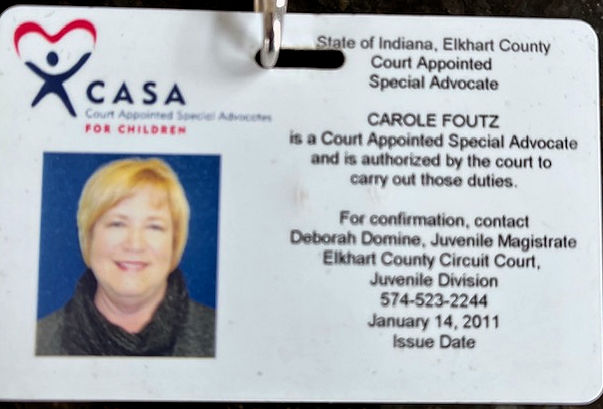
I have worked as a CASA now for more than 10 years. During that time, I have had cases which eventually went to adoption, cases where another family member was appointed guardian, or the case was closed as the parents were deemed ready to provide a safe and nurturing home for the child. At least 75% of the cases usually are closed with parents fulfilling the requirements DCS (Department of Child Services) has asked of them.
The personal contacts with these children and families have been very rewarding. Yes, not always do I have positive experiences, but receiving pictures, notes, Christmas Cards from families I have worked with is very heartwarming. I’ve had one family who adopted 3 male siblings, one year to 5 years old. Every Christmas I enjoy getting their card with pictures and reports of their activities and accomplishments. I can’t help but feel the “system” worked for them and their lives have a very promising future. Therefore, I feel I can help in this process in a small way.
About CASA
I want to give you a little background of CASA, the requirements and the job description. There is no typical CASA. They come from every profession, and many are retired.
The CASA Program began in Seattle, Washington in 1977. A superior Court Judge experienced a disturbing and reoccurring problem in his courtroom. He felt that pertinent information in cases regarding the lives of children seem inaccessible and unavailable causing him to make decisions regarding cases without sufficient knowledge. The additional piece needed was someone involved the child’s case who could facilitate the child’s development, growth, and safe living. This person would be an advocate for the child regarding decisions made in and out of the courtroom.
In Elkhart County the CASA Program began in 1983. It is affiliated with both the State and National organizations. There are more than 76,000 advocates working in nearly 1,000 state and local programs. They are often known by different names but are all part of the NCASAA (National Court Appointed Special Advocate Association). Since its inception, the CASA volunteers have helped child victims of abuse and neglect find safe, permanent homes in which they can thrive.
What does a CASA do? The initial step is getting to know the child. A child is initially declared a CHINS (Child in Need of Services). This means that this child is in the child welfare system and is in need of services due to abuse or neglect. That can mean many different things. If the child is in a home that is not safe due to drugs, lack of a clean, safe environment, etc. the child a CHINS. A volunteer then needs to find out as much about the case as possible. A CASA has access to most documents and records both in and out of the court. The advocate becomes a regular visitor with the child. This may be in the home, foster home, or specific visitation agency. When having a very young child/baby, most of the time you visit and get to know what the daily routine and life of the young child is like. With an older child, you can take them to get something to eat, go to a park, etc. You become their adult friend.
A CASA’s other responsibilities are to investigate and get to know all aspects of the case. This means that you are directly involved with the DCS caseworker assigned to the child and family. You must be very much aware of the parent’s mandated services. This is a must with the courts and their path toward closing the case. An advocate must provide documents and reports about visits and observations. An advocate appears in court and the judge asks the CASA questions concerning the child and CASA’s recommendations. Another important job a CASA may have, is to recommend services for the child to the court which the volunteer feels that would beneficial.
As we all know, kids don’t get to choose their parents or how they grow up. We also know that a child begins learning from the day of birth. Every day of a child’s life is so important. A parent can send them to school for several hours a day, but the school will never replace their home or parent. When that place or person fails, someone must be there for that child. The CASA Program attempts to help with that need.
Many of us have extra time and energy in our retirement years, and you might find being a CASA volunteer rewarding for you, as it has been for me. If you are interested contact me. I’ll be happy to get you started.
 Penn Class of '65
You must be logged in to post a comment.