
Do you remember that first spring when we were walking through the halls at Penn High School and heard that Alan Shephard had made the first manned spaceflight? It was May 5, 1961. A lot has happened since then and in 2024…
We’re going to Mars!
And I have been right in the middle of all that change! Who would have thought that someone who doesn’t care for math and science would be in Alabama and working for NASA? But I am (ask me about how I got there later) and I am very excited about working for NASA.
But, before we go to Mars, we need to go back to the moon and build an outpost …and that is in the testing stage now. The first flight of Artemis 1 is set for late spring or early summer. It will be an unmanned flight to circle the moon and come home to test all the hard work we have done over the last few years.
I went to work as an accountant for a NASA contractor – Jacobs, formerly Jacobs Engineering Group, in 2000. I retired in 2012. I was asked to come back to work on a special project eight years ago and am still here. One of my favorite projects is to help with our college intern class every summer – their hours are filled to the brim with exciting work with engineers and scientists and tours of the labs and test stands based at Marshall Space Flight Center in Huntsville, AL. Watching a bunch of college students making their way in this world of space exploration is inspiring.
For the last few years our group has been working on the Space Launch System (SLS). By the way, NASA speaks in abbreviations. Everything, and I mean everything, has an abbreviation. We even have a dictionary of abbreviations so you can learn the language. But I digress….
Our company manages several key pieces of this endeavor. We have the ITAF- SIL, which is the Integrated Avionics Test Facilities – Simulation Integration Lab. This facility matches the diameter of the SLS and is a digital twin of the brains of SLS. This facility not only includes flight computers and avionics identical to SLS, but also emulators for the rocket’s boosters and engines, the Launch Control Center, and the Orion crew capsule.
We have test stands built to test the engines that will propel the rocket into space. They were built years ago and were used to test engines for the shuttle launches. They have been refurbished and are now used to test the much more powerful engines that will send future astronauts to the moon and Mars. I live a few miles away and can hear them testing – from a few seconds to several minutes.
We also have a Human Factors team, which plays a key role in developing the size and shape of articles so that all the astronauts will be able to work easily in space. One wouldn’t think it would matter about the size and shape of a hatch – but it needs to be accessible to a 6’4” person as well as a 5’2” person.
We are super excited that NASA will launch Artemis 1 in April. Artemis 1 is the first unmanned test flight using the agency’s Space Launch System super heavy lift launch vehicle and the first flight of the Orion crew capsule. It will launch from Kennedy Space Flight Center (KSC). Find out more at NASA.gov/Artemis.
This picture on the right is of the ITAF-SIL – the brains of the SLS rocket.
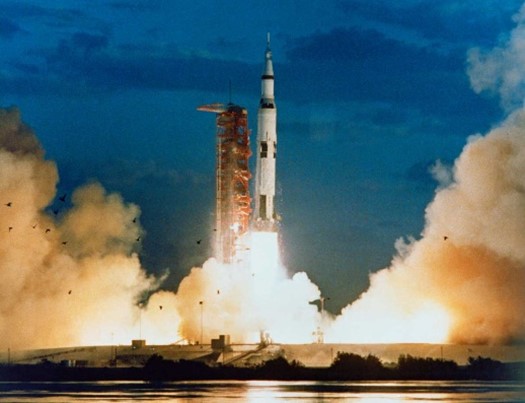
The picture on the left is of the Saturn rocket.

The Space & Rocket Center (U.S. Space & Rocket Center | Home of Space Camp) is one of the top space related destinations in the country. You should take the time to visit if you are ever in the area. And, if you decide to visit, look me up…. I’ll be happy to brag about our town.
 Penn Class of '65
You must be logged in to post a comment.